From Shepherd Boy to Shepherd
Jam WU’s Creative Trajectory and the Practice of “Cut ( )”
By HSU Fong-Ray
Commentary / ART COLLECTION + DESIGN / November 2012https://www.jamwu.com/profile.html“…It does not require our glance or our touch. It does not feel itself being seen or touched. The fact that it falls onto the windowsill belongs to us, not to its own experience. For it, this is no different from falling elsewhere. It is uncertain whether it has completed its fall, or is still falling…”
— Wisława Szymborska, View with a Grain of Sand
I first met Jam WU in the summer of 2010. He loved poetry—Xia Yu, Sun Wei-min, and the writings of Wisława Szymborska. What truly caught my attention, however, was the scene of him holding a pair of scissors with golden handles, cutting fallen leaves and red paper. Beside the vast grassy field of Huashan, a white architectural structure stood quietly, its walls covered with resting red butterflies and red paper flowers climbing up from the corners, composing a poetic summer afternoon.
Large red paper flowers and symbolic forms—these strong visual elements easily become rapid, consumable visual memories through fragmented media images. They allow viewers to quickly register the creator before them as Jam WU and classify him as a “paper-cutting artist.” Such stereotypes belong to a scenic mode of perception. For Jam WU, however, this is merely a process. His practice of cutting (paper) does not fully inherit the signifying system of traditional culture, nor does it aim to reproduce misplaced historical cultural assets. Instead, he disentangles traditional elements through interpretations rooted in individual life experience, assembling contemporary texts and transforming them into his own creative trajectory—using the act of “cutting” as a form of personal cultural practice.
Setting Out on a Nomadic Journey: From Yi Poetry
In 2002, Jam WU left Tainan—a place that, for him, had been lonely, harsh, and closed—and moved north to Taipei to pursue his studies. Upon arriving, his talent for poetry and writing quickly drew attention, leading to his participation in the editing and publication of Yi Poetry. At the time, Yi Poetry was a publication marked by strong experimental tendencies, developing a nationwide poetry movement through formal and linguistic strategies.
This period marked Jam WU’s first encounter with the experimental and diversified impact generated by the transition between southern and northern living environments. His university training in architecture further sharpened his sensitivity and intuition toward spatial situations and compositional elements. During this time, he developed a series of works that used emotional projection as a medium to respond to lived environments. The creative awakening of his student years emerged from the collision between rural and urban cultures, while environmental experience and professional training laid the foundation for his later flexible manipulation of spatial form and his pursuit of balance across diverse media.
Maternal Art and Feminine Writing on the Loess Plateau
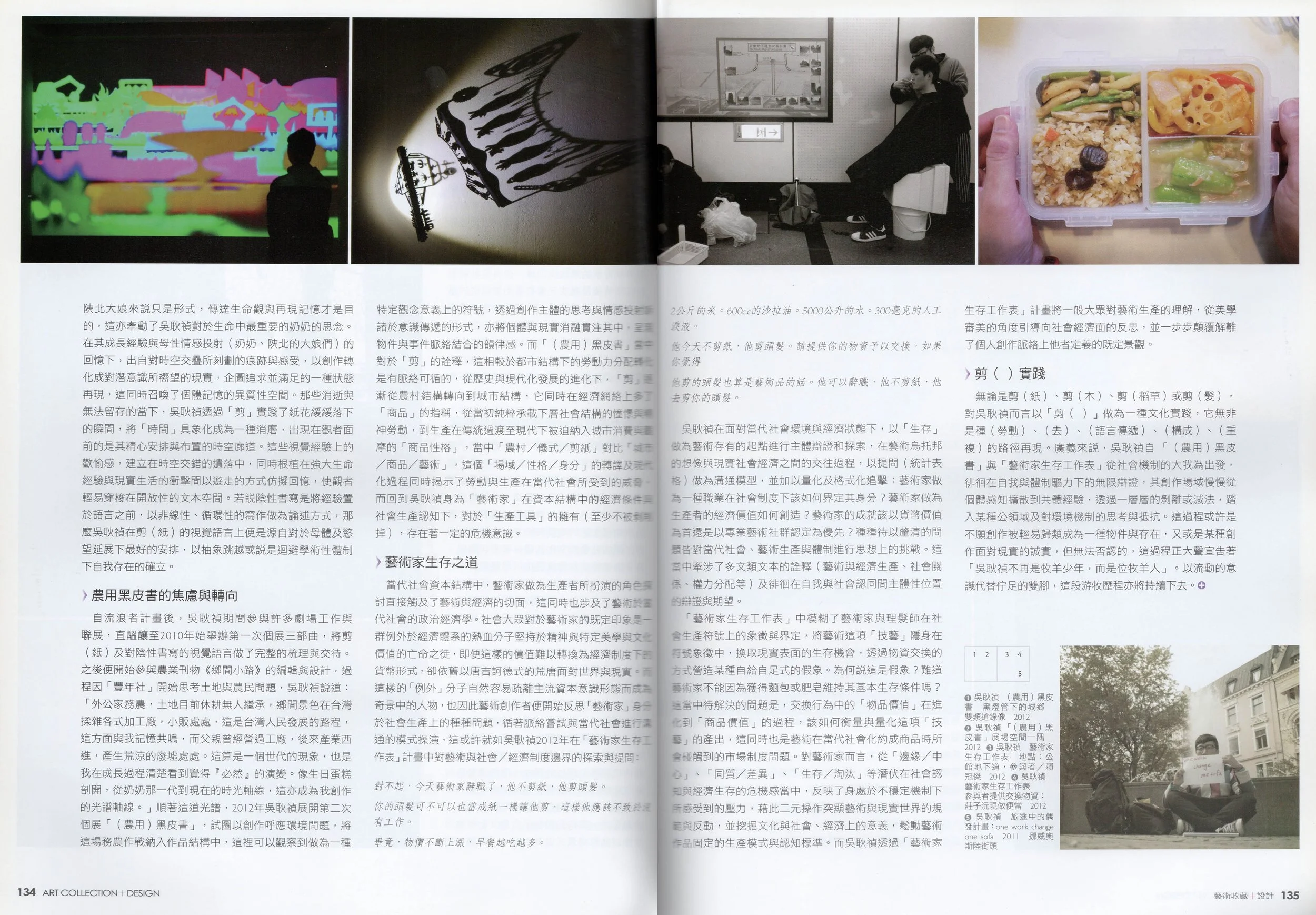
In 2006, Jam WU received support from the Cloud Gate Wanderer Project and traveled to northern Shaanxi to explore the culture of paper-cutting. From cutting by a campus swimming pool to cutting on the Loess Plateau, he chose paper-cutting as both a creative outlet and an emotional practice. Upon arriving in Shaanxi, he encountered a geographically closed environment in which people expressed their longing for and pursuit of a good life through paper-cutting—a practice closely tied to the closed social and cultural structure of rural China and primarily passed down by local women as a form of maternal art.
Through long-term social practice and psychological need, paper-cutting gradually formed systems of visual meaning, psychological resonance, and lived experience. This creative thinking and practice also functioned as a cultural medium for transmitting information, communicating emotion, and articulating consciousness. Rooted in the land of laborers’ everyday lives, this cultural transmission fulfilled spiritual needs while manifesting as aesthetic concepts and cultural symbolism.
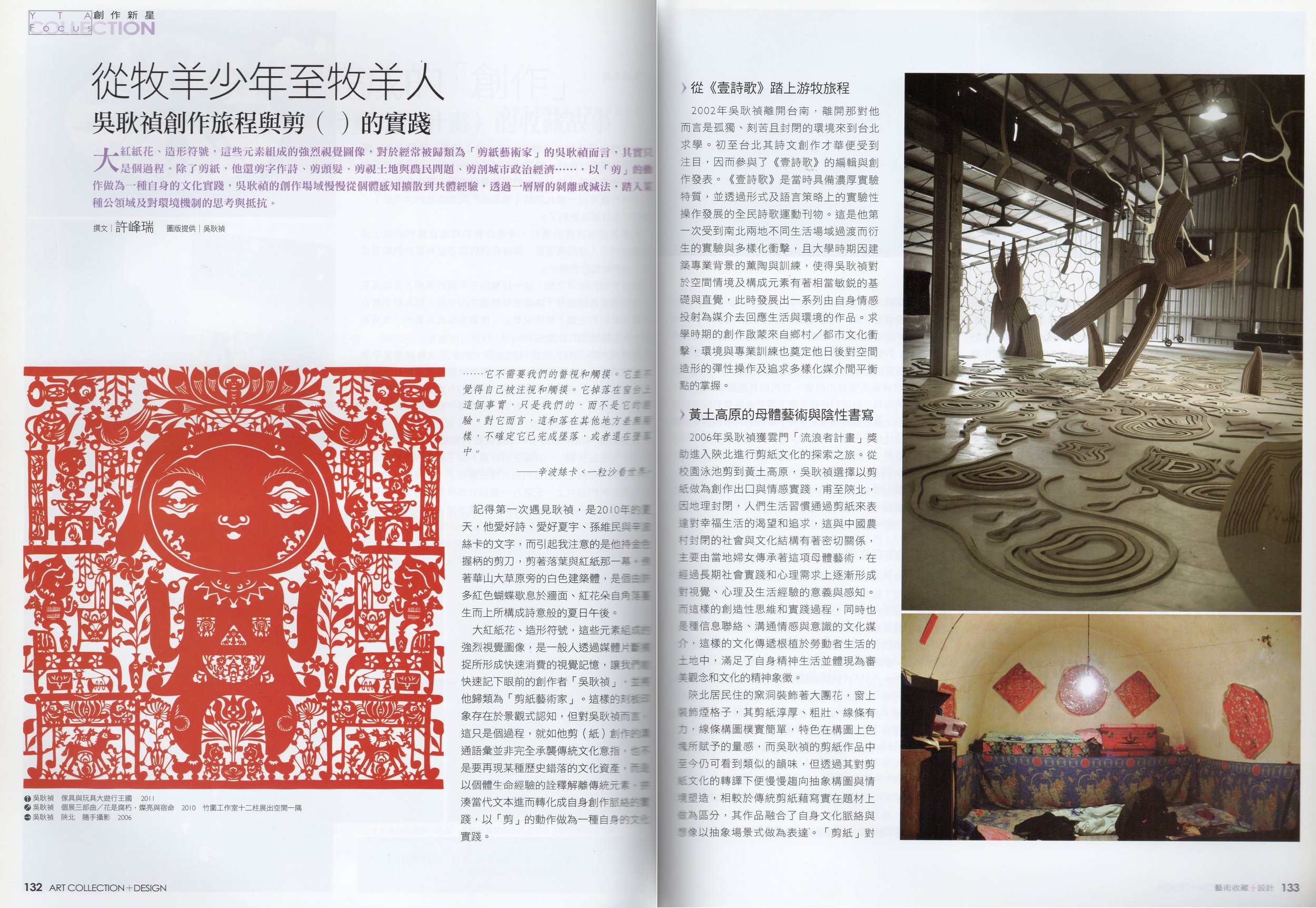
The cave dwellings of northern Shaanxi are decorated with large floral patterns and lattice-cut window ornaments. The paper-cuttings are thick, robust, and forceful, with simple, powerful compositions defined by the weight of colored forms. Similar qualities can still be seen in Jam WU’s work today. Yet through his translation of paper-cutting culture, his practice gradually moved toward abstraction and the construction of atmosphere. In contrast to traditional paper-cutting, which often distinguishes itself through representational subject matter, Jam WU’s works integrate his own cultural context and imagination, using abstract scenographic expression.
For the women of northern Shaanxi, paper-cutting is merely a form; the true purpose lies in conveying a worldview of life and re-presenting memory. This resonated deeply with Jam WU’s longing for his grandmother—one of the most important figures in his life. Drawing upon memories of growth and projections of maternal affection (his grandmother and the women of Shaanxi), his work traces the marks and sensations of overlapping time and space, transforming creative practice into a realization of subconscious longing. This process summons heterogeneous spaces of individual memory.
Those fleeting moments that disappear and cannot be preserved are enacted through Jam WU’s practice of “cutting,” capturing the slow descent of paper flowers and rendering “time” tangible as a form of erosion. What appears before the viewer is a carefully arranged corridor of time and space. The pleasure of these visual experiences is grounded in the remnants of temporal disjunctions, rooted in powerful life experience and the shocks of reality, allowing viewers to move freely through an open textual space. If feminine writing places experience before language, using non-linear and cyclical narration, then Jam WU’s visual language of cutting (paper) emerges as an arrangement derived from maternal origins and the extension of desire—an abstract leap, or perhaps an evasion, from the academic institutionalization of self-definition.
Anxiety and Redirection: The (Agricultural) Black Cover Book
After the Wanderer Project, Jam WU participated in numerous theater projects and group exhibitions. These experiences culminated in 2010 with his first solo exhibition trilogy, which fully articulated his practice of cutting (paper) and its relationship to feminine writing. He subsequently joined the editing and design team of the agricultural magazine Xiangjian Xiaolu (Country Road), during a period when Fengnian Press began to reflect on issues of land and farmers.
Jam WU remarked: “My maternal grandfather farmed the land, which is now lying fallow with no one to inherit it. Rural landscapes in Taiwan have become mixed with processing factories and street vendors everywhere. This is the path of Taiwan’s development—it resonates with my memory. My father once ran a factory; later, industry moved westward, leaving desolate ruins behind. This is a generational phenomenon, something I witnessed growing up and felt was ‘inevitable.’ Like cutting open a birthday cake, the timeline from my grandmother’s generation to now has become the spectral axis of my creation.”
Following this trajectory, Jam WU launched his second solo exhibition in 2012, The (Agricultural) Black Cover Book, attempting to respond to environmental issues by integrating agricultural struggle into the structure of his work. Here, symbolic elements operate as vehicles for transmitting consciousness through the artist’s thought and emotional projection, dissolving the boundary between individual and reality. Objects and events are woven into rhythmic structures.
Within The (Agricultural) Black Cover Book, the interpretation of “cutting” can be traced through the transformation of labor distribution under urban structures. Historically, as modernization progressed, “cutting” shifted from rural to urban contexts, acquiring the designation of “commodity” within economic networks. What once carried the aspirations and spiritual labor of subaltern social structures was gradually forced into urban consumption and spectacle. The contrast between “rural / ritual / paper-cutting” and “urban / commodity / art” reveals how modernization exposes the threats faced by labor and production in contemporary society. For Jam WU, positioned as an “artist” within capitalist structures, the question of owning—or at least not being dispossessed of—“means of production” carries a distinct sense of crisis.
The Artist’s Way of Survival
In contemporary capitalist structures, the role of the artist as producer directly touches upon the intersection of art and economics, involving the political economy of art in contemporary society. Public perception often casts artists as passionate outsiders to economic systems—Don Quixote-like figures clinging to spiritual and aesthetic values that resist monetary conversion. This “exceptional” status easily marginalizes artists from mainstream capital ideology, turning them into spectacles.
In response, artists have begun to reflect on their social identity as producers, experimenting with modes of communication that engage contemporary society. This is evident in Jam WU’s 2012 project Artist Survival Worksheet, which explores and questions the boundaries between art and socio-economic systems:
Sorry, today the artist has resigned.
He does not cut paper; he cuts hair.Can your hair also be treated like paper for him to cut?
That way, he might not be without work.After all, prices keep rising,
and breakfast keeps getting more expensive.2 kilograms of rice.
600 cc of salad oil.
5,000 liters of water.
300 milligrams of artificial tears.Today he does not cut paper; he cuts hair.
Please offer your supplies in exchange,
if you believe that the hair he cuts can also count as art.
He can resign—he does not cut paper;
he cuts your hair.
— Jam WU
Confronting contemporary social and economic conditions, Jam WU takes “survival” as the starting point for dialectical exploration of artistic existence. Using questioning—through statistical tables—as a communicative model, he quantifies and formats these inquiries: How should the identity of the artist be defined within social systems? How is the economic value of artistic production generated? Should artistic achievement be measured by monetary value or by recognition within professional art communities?
Artist Survival Worksheet blurs the symbolic distinction between artist and barber, concealing art as a “skill” within symbolic exchange to secure surface-level survival through material barter. This produces a self-sufficient illusion, raising unresolved questions about how the value of skill is measured when objects evolve into commodities. It exposes the pressures faced by artists within unstable systems, mobilizing binary tensions—margin/center, sameness/difference, survival/elimination—to challenge normative frameworks and loosen fixed modes of artistic production and evaluation.
The Practice of “Cut ( )”
Whether cutting (paper), cutting (wood), cutting (straw), or cutting (hair), Jam WU treats “cut ( )” as a cultural practice—a reenactment of paths such as (labor), (removal), (transmission of language), (composition), and (repetition). Broadly speaking, from The (Agricultural) Black Cover Book to Artist Survival Worksheet, his practice departs from social mechanisms at a collective scale, oscillating between self and institutional forces in continuous dialectics. His creative field gradually expands from individual perception to shared experience, entering public space and engaging with mechanisms of environmental thought and resistance through processes of subtraction and stripping away.
This trajectory may stem from a refusal to allow creation to be easily classified as object or fixed existence, or from an insistence on honesty in confronting reality. What cannot be denied is that this process loudly declares: Jam WU is no longer a shepherd boy, but a shepherd. Replacing stationary footsteps with a mobile consciousness, this nomadic journey continues.